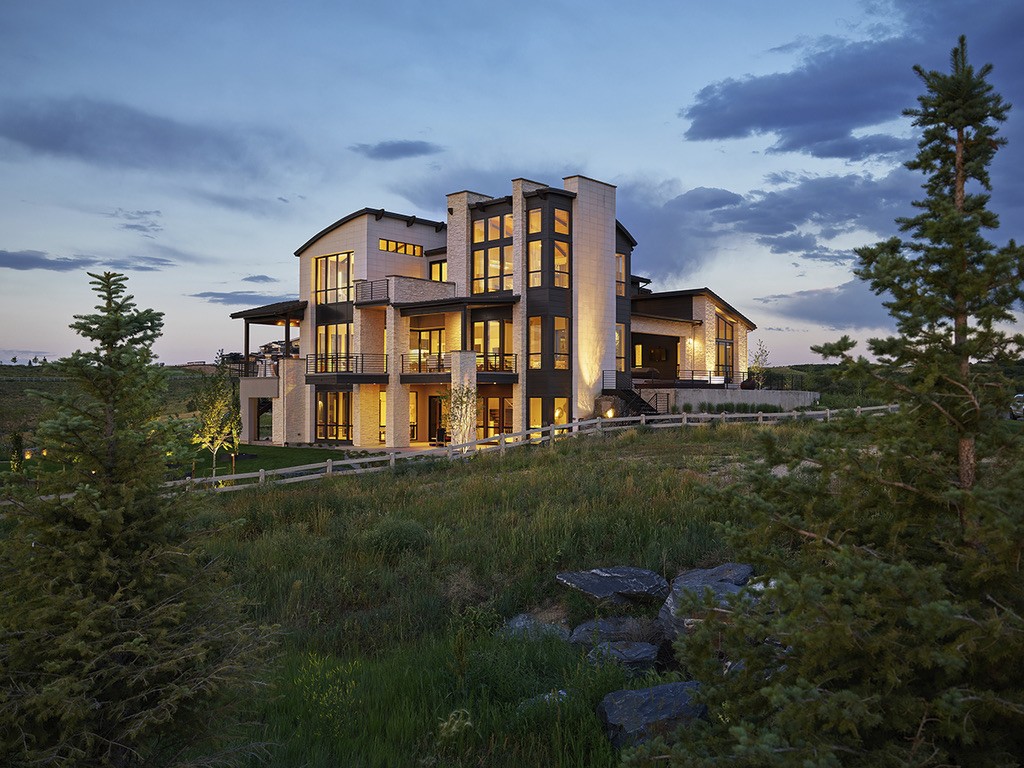
A luxury home can carry 150 loads of lighting fixtures. Often more. The question nobody asks until the house is finished is how anyone is supposed to manage them.
Start with the wall plate
Count the switches on a single plate in your main living area. Five? Six? Now ask which one runs the cove lighting. Nobody in the house knows, so people press all of them until the room looks right, and the plate itself is a row of paddles on a wall that somebody paid an architect to design.
Then there is the nightly question: who turns the lights out? The last person to bed? Whoever happens to be closest to the switch? In most houses the answer is that half of them stay on.
One button turns off the house
An all-off button takes the hassle out of retiring for the night. One press, every controlled load off. You can also run it on a schedule, so the house dims itself down at a set time whether anyone remembers or not.
Better still, tie it into the control system so the same button that arms the security system and locks the doors also kills the lights and the house music. Leaving in a hurry stops being a question of whether you left something on.
Keypads instead of switch banks
A multi-gang plate of switches gets replaced by a single-gang keypad, available in designer colors with sleek screwless plates. The wall gets quieter, and the buttons are engraved with what they actually do rather than leaving you to guess.
Scenes are the real point
Most rooms have several sources of light for different reasons: accent lighting that highlights an architectural feature, ambient light that sets the mood, task light you actually read by. On switches, combining them means operating four controls in sequence and getting it slightly wrong every time.
A lighting scene sets all of them at once, at levels chosen when the room was designed and furnished. One preset button recalls it. The difference between a room with good lighting design and a room with a lot of light fixtures is almost entirely down to whether anyone set up the scenes.
The energy math is better than people expect
Running a light at 90 percent saves roughly 20 percent of the energy it would draw at full, and the drop is barely perceptible to the eye. Scenes almost never call for full illumination anyway. The system saves money while making the room look better, which is a rare combination.
The fixtures matter too
Control is only half of it. Historically a lamp came at a fixed color temperature, warm or cool, chosen at the moment of purchase. Change your mind later and you replaced the lamp.
Tunable white fixtures removed that limitation. ESC is a dealer for DMF Lighting, whose tunable fixtures adjust across a range of 4000K to 1800K or 6500K to 2700K depending on the model. Their Artafex line lets different lamp types share a single rough-in bracket, which is an industry first and a genuine convenience when a room gets changed years later.
At the top end, Ketra takes the same idea further, following the daily curve of natural light and holding above 90 CRI across its whole range.
Who makes these systems
Lutron, Control4, Crestron and Savant have been building lighting control for decades. The products are reliable, straightforward to live with, and cost-effective at this point. ESC installs all of them, and as a Lutron Diamond Dealer we do the majority of our lighting work on Lutron RadioRA 3 and HomeWorks.
You do not have to do the whole house
Whole-home control is the ideal, but doing the primary areas first is a legitimate approach and a common one. Kitchen, great room, primary suite and exterior cover most of the daily use. The system expands later.
Decide before the drywall
Lighting control changes the wiring topology. Panelized systems need the load schedule handed to the electrician, and they need panel space. Keypad locations want deciding while walls are open, not after the painter has left. Bring it up during design, alongside the electrical plan.
Talk to us about your lighting
Electronic Services and Concierge is a Lutron Diamond Dealer in Lakewood, Colorado, designing and programming lighting control for homes across the Denver metro area, Summit County and Vail.
Call 720-532-0199, or read about the other half of the equation: motorized shades.